
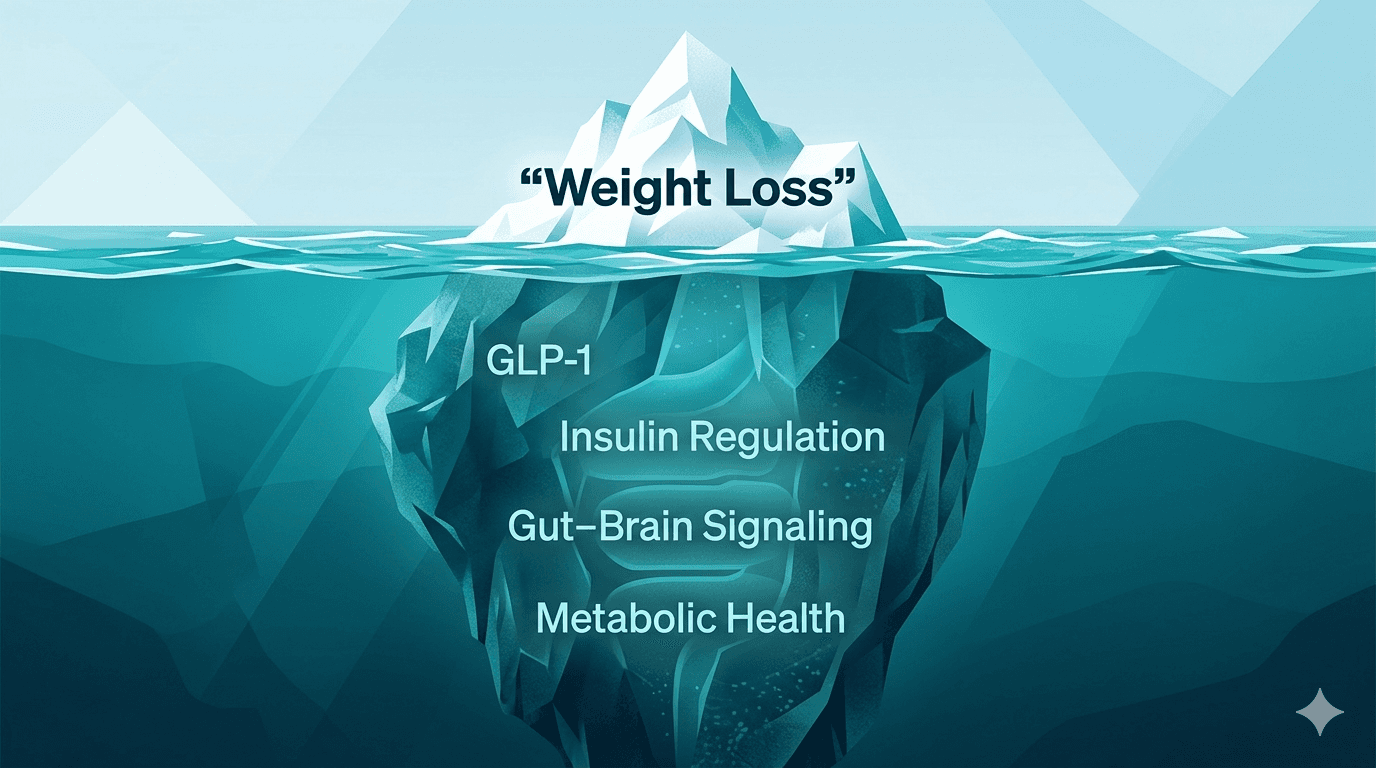
We are a culture obsessed with what we can see. We track steps on our wrists, calories on our apps. It makes sense. In a world that feels increasingly complex, a single, tangible number feels like a win.
This is exactly how a medication originally designed to help the body manage insulin became a global cultural phenomenon. But the story of Ozempic isn’t just about a drug; it’s about a marketing masterclass that capitalized on our deep-seated desire for instant, visible gratification.
The biology that doesn't make headlines
GLP-1 — glucagon-like peptide-1 — is released in your gut when you eat. It tells your pancreas to produce insulin. It slows the rate at which your stomach empties. It crosses into the brain and signals that you've had enough.
It's elegant, really. A single hormone doing several jobs at once, sitting at the intersection of metabolism, appetite, and blood sugar regulation.
But here's the thing about that intersection: it's invisible. You can't photograph insulin sensitivity. You can't post a before-and-after of improved mitochondrial function. Chronic inflammation doesn't have a look.
So when Ozempic started working — really working — what people noticed was the part they could see: weight loss.
At that moment, the narrative shifted. Marketing, by its nature, looks for the shortest path to a human’s heart. "Improved insulin sensitivity" is a hard sell; "the jeans you wore in college" is an easy one. The focus moved from the cellular mechanism to the mirror, rebranding a complex metabolic corrective as a "weight-loss jab".
We respond to what we can measure
This isn't a flaw unique to media coverage or pharma marketing. It's something closer to a default setting in how humans process information.
Weight is legible. It's a number. It fits on a scale, in a headline. The metabolic dysfunctions that precede and drive obesity — insulin resistance, gut-brain signaling disruption, chronic low-grade inflammation — are not legible in the same way. They require context. They require explanation. They resist the single metric.
And so the visible outcome — weight loss — became the story. Not because it's the most important thing Ozempic does. But because it's the easiest thing to see.
The vacuum that marketing didn't create, but filled
It would be easy to frame this as a story about pharmaceutical cynicism. A company sees an opportunity, repositions its product, cashes in.
But that's not quite what happened — or at least, it's not the whole picture.
Novo Nordisk didn't manufacture the weight-loss narrative. In many ways, the science communication world handed it to them. The complex story of GLP-1 biology — the one about metabolic disease, about the gut-brain axis, about what insulin resistance actually means for long-term health — that story existed. It just never found a form that spread.
Marketing is very good at one thing: finding the most legible version of something and amplifying it. When the legible version happens to be accurate — weight loss is a real effect of Ozempic — it's hard to call that dishonest. It's just selective. And selective, in a vacuum, becomes the whole truth
The Marketing Blitz and the Regulatory Wall
On March 20, 2026, the patent for semaglutide expired in India, opening the floodgates for over 50 generic versions from major domestic players. We are entering a "generic revolution" where prices are expected to drop by as much as 50-90%.
In this new landscape, "weight loss" is about to become a commodity. When dozens of brands are promising the same visible result at a fraction of the cost, the old marketing playbook of selling "thinner waistlines" will no longer be enough to build trust or differentiation.
We’ve already seen the first signs of this shift hitting a wall. In early March, CDSCO issued a stern warning against "surrogate marketing"—the practice of using "disease awareness" or influencer reels to indirectly promote prescription weight-loss drugs. The regulator is effectively saying that we cannot treat a medical tool as a lifestyle accessory. When we market only the visible symptom, we inadvertently tell the world that the underlying cause (metabolic health) doesn't matter.
Why the "Invisible" Matters More
By focusing only on what the scale says, we miss the most consequential drivers of our health. These are the things that rarely shape public demand because they are harder to see and harder to explain in a single metric.
The irony is that science communication already has the better story. Cellular repair. Food noise quieting. A gut-brain axis finally working the way it was meant to. These aren't just more accurate — they're more interesting than a number on a scale.
But interesting doesn't spread on its own. It needs a form. And finding that form — making the invisible legible without flattening it — is the actual challenge. Not for pharma. For anyone who thinks the full story of metabolic health is worth telling.
The SciComm Solution: Marketing the Invisible
If we are to bridge this gap, the work isn't just about "better" communication; it’s about a fundamental reframe. We have to steal a page from the marketing playbook—not to sell a lifestyle, but to make the invisible biological reality feel tangible. This is the pivot from "Weight Loss" to "Signal Repair." To do this, we have to move beyond clinical jargon and show people what "Cellular Quiet" actually looks like.
This allows us to address the root cause rather than the symptom. It’s a shift in evidence-led storytelling: moving away from the tired "Before/After" photos of waistlines and toward "Internal/External" progress reports. Success in this new era isn't just a number on a scale; it’s a stabilized glucose curve and the quiet confidence of a body that finally trusts its own hunger signals.
The Way Forward
The science existed before the cultural moment did. The biology of GLP-1 was understood years before Ozempic became a household name. What changed wasn't the evidence — it was which part of the evidence found an audience.
That gap, between what science knows and what culture hears, isn't unique. It shows up everywhere chronic disease intersects with visibility, with aesthetics, with the stories we find easier to tell. Ozempic just made it unusually easy to see.
In an era of instant gratification, the most radical thing a brand can do is be honest. As generic versions of these drugs become widely accessible, the brands that win won't be the ones that promise the fastest results. They will be the ones that provide the most clarity.