
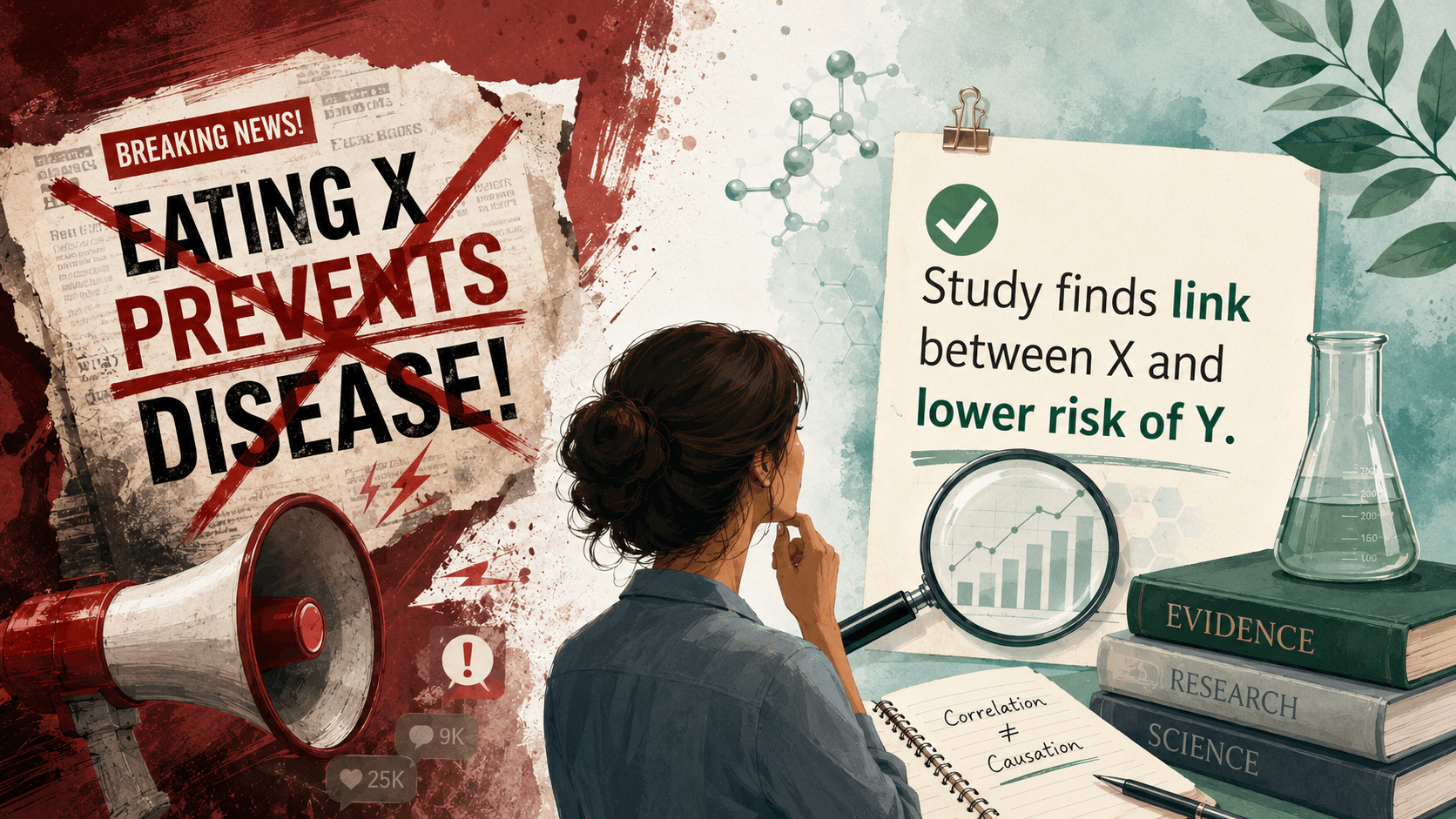

Every science communicator has heard the same advice: don't use jargon. I agree with it. Technical language can stop readers before they ever reach the science. But over time, I've realised that replacing difficult words is only the beginning.
The harder part starts once the jargon is gone. It's making sure the evidence means the same thing to the reader as it did in the research paper. That's not always easy. Sometimes a single word can make a finding sound more certain than it really is, or a careful observation can become a confident conclusion.
I've come to think that translating evidence is more about making careful choices. The choices that shape what readers take away from a study, what they question, and what they trust. Those are the choices I find myself thinking about every time I write.
It Is Not Just About Replacing Difficult Words
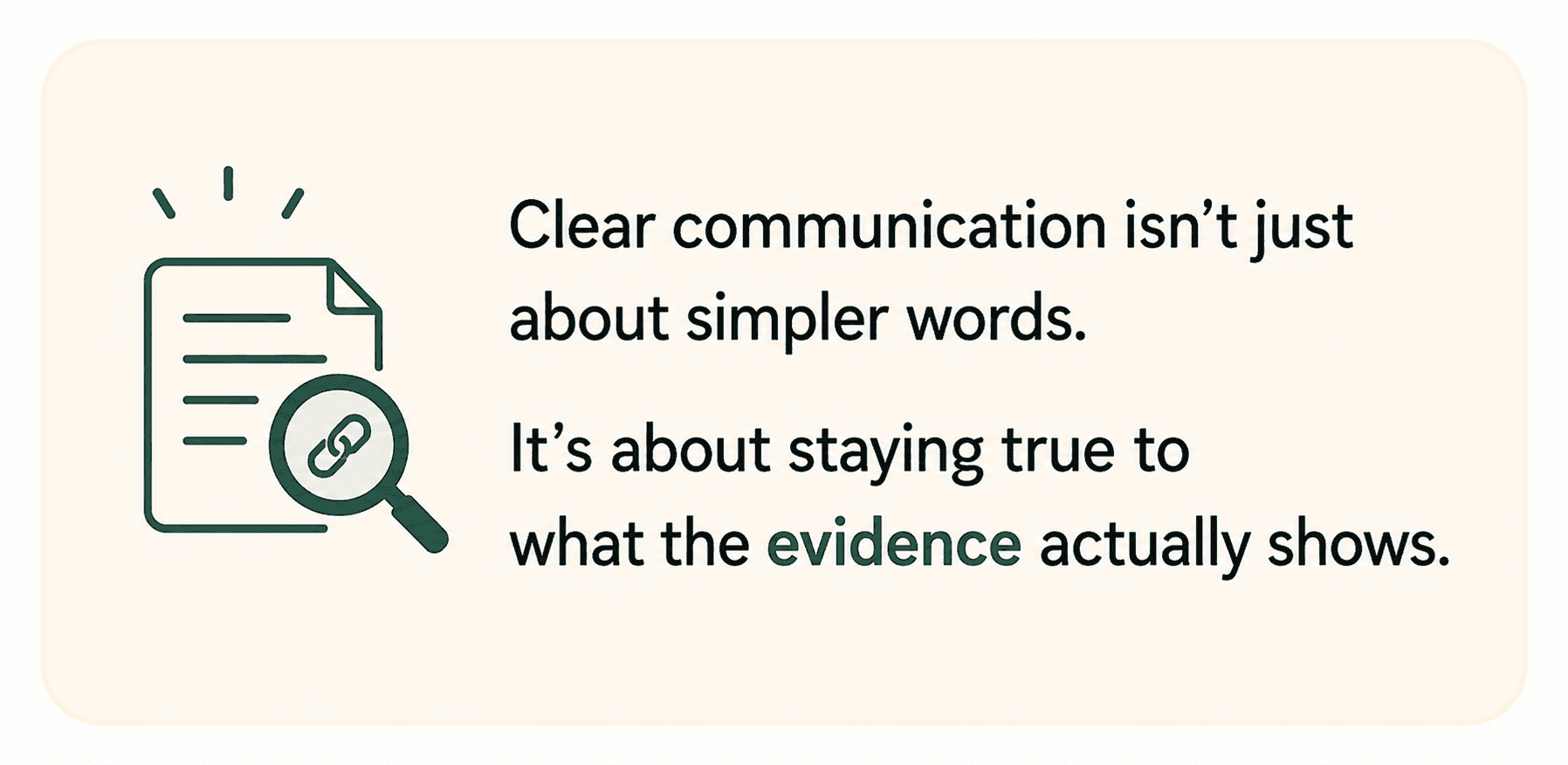
It's easy to think the hardest part of science communication is replacing technical words with simpler ones.
Take this sentence:
“Women who ate more nuts had a lower risk of heart disease.”
At first glance, it seems clear enough. Most readers would understand every word. Yet it's just as easy to finish reading and conclude that eating nuts protects the heart. That's not what the study found.
The researchers observed that women who ate nuts more often also had a lower risk of heart disease. They couldn't tell whether the nuts explained that difference, or whether other parts of their diet and lifestyle played a role too. This small distinction is very easy to lose.
Writing has made me realise that understanding a sentence isn't always the same as understanding the evidence behind it. These days, I spend less time asking whether a sentence is easy to read and more time asking what someone is likely to take away from it. Those aren't always the same thing.
That's where careful science communication begins. It's not simply about making research easier to read. It's about making sure the meaning survives the translation.
Talking About Uncertainty Without Scaring People Away
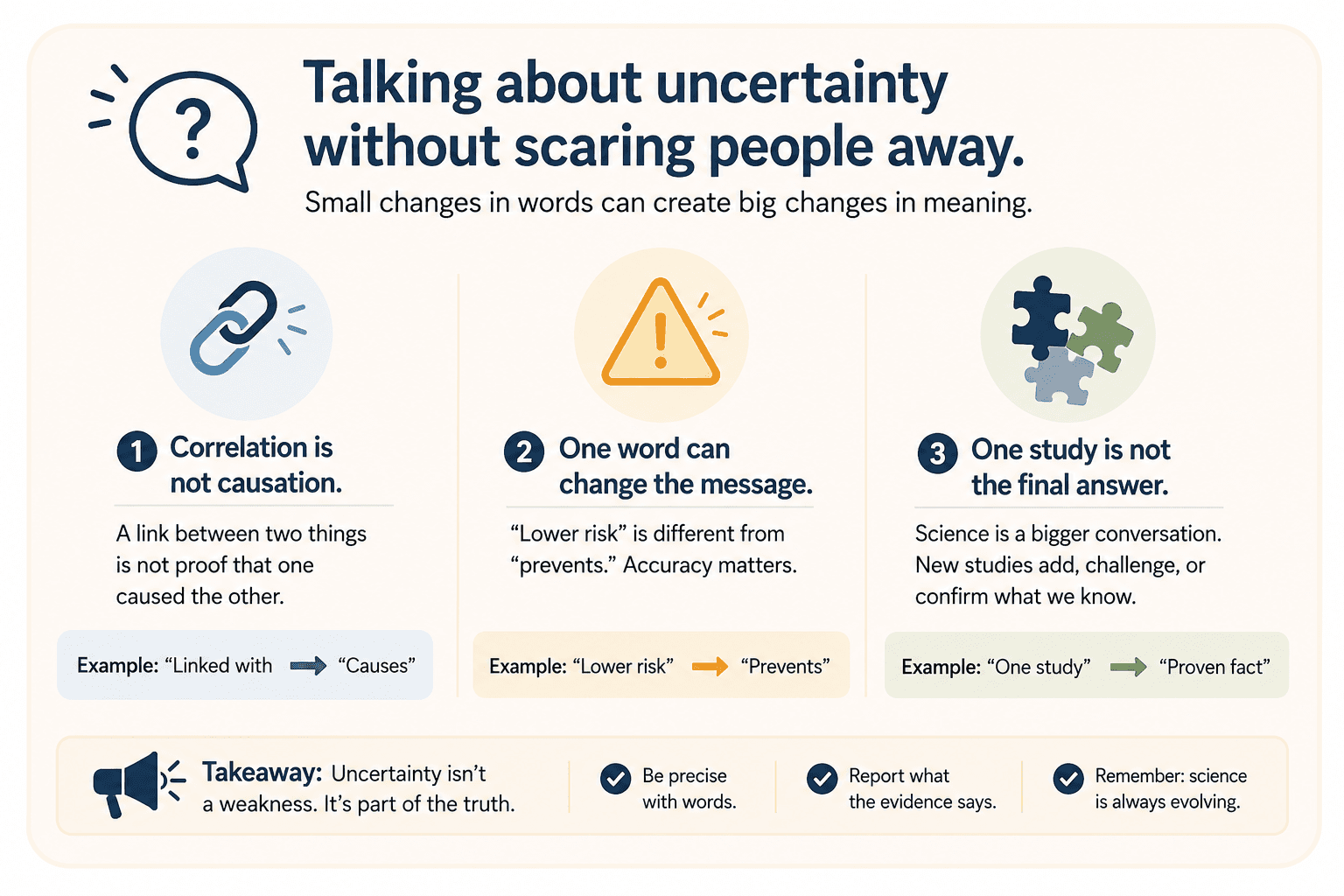
The biggest shifts in meaning rarely come from one obvious mistake. More often, they creep in through small changes that seem harmless at the time.
One of the easiest mistakes is turning correlation into causation. A study might find that people who exercise regularly also tend to sleep better. That's a link between two things, not proof that one caused the other. Yet it's easy to shorten that into "Exercise improves sleep." A study published in The BMJ found that this kind of shift is common in health reporting. The sentence is cleaner, but it says more than what the evidence supports.
I've noticed something similar with risk. A study might report that one group had a lower risk of developing a disease. By the time the finding reaches a headline, "lower risk" has become "prevents." It's only one word, but it changes the message. One reflects what the researchers found. The other suggests a certainty they never claimed. Uncertainty isn't a weakness in writing. It's part of the truth.
The same thing can happen with a single study. A new paper is published and, before long, it starts to sound like the final answer. In reality, most studies are just one part of a much larger conversation. Some confirm earlier work, some challenge it, and others simply add another piece to the puzzle. When we forget that, readers lose more than context. They lose trust when the next study tells a different story.
Context Matters Just As Much As the Statistic
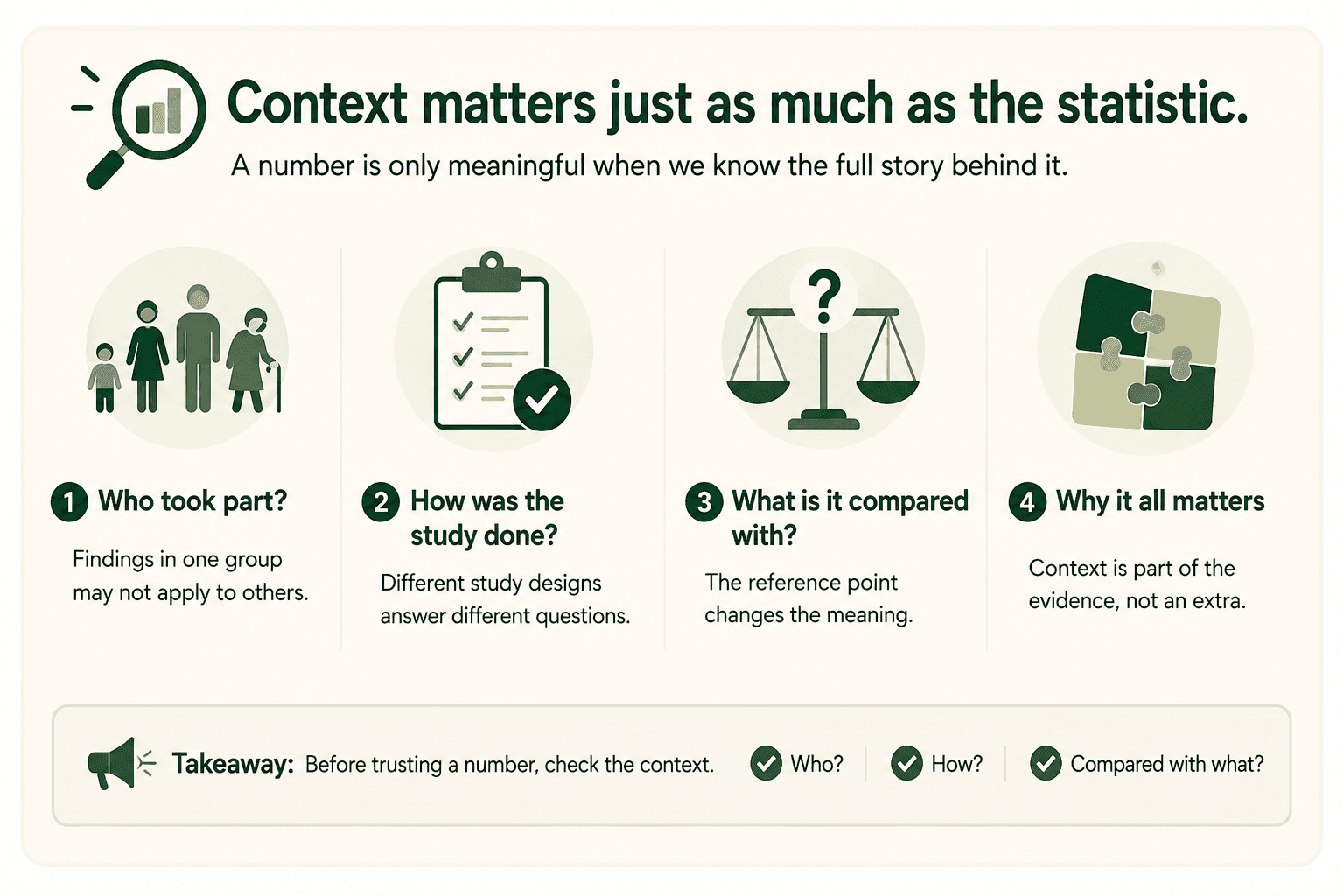
Numbers have a way of sounding convincing on their own. But I've learnt that it's usually the context around them that gives them meaning.
When I read a study now, one of the first things I look for is who actually took part. A finding in healthy young adults may not apply to children, older adults, or people with existing health conditions. I became much more aware of this while writing about skin changes during the menstrual cycle, where the characteristics of the study group shaped how far the findings could be applied.
I've also started paying closer attention to how a study reached its conclusions. Some studies simply observe patterns, while others compare treatments under carefully controlled conditions. Both add to our understanding, but they don't answer the same questions. If that distinction disappears, readers can easily place more confidence in a finding than it deserves.
The comparison matters too. Saying a treatment "reduced risk" sounds impressive until you ask, Compared with what? Another treatment? A placebo? No treatment at all? Without that detail, the number tells only part of the story.
I've come to see context differently. It isn't an extra detail added for completeness. It's part of the evidence itself. Leave it out, and the statistic may still be accurate, but the reader's understanding won't be.
A Few Things I Now Check Before I Publish
Over time, I've found it useful to pause before I publish and ask myself a few final questions.
Have I told the whole story? Have I included the benefits, limitations, and possible harms where they're relevant?
Would this make sense to someone outside my field? Have I explained the evidence in clear language without losing its meaning?
Have I shown how big the finding really is? Could a reader understand what the numbers mean in real life, not just on paper?
Does the headline reflect the evidence? Does it stay as careful as the study itself, or does it promise more than the research can support?
Can readers find the original research? Have I pointed them to the study so they can explore the entire evidence for themselves?
These aren't rules, and they don't guarantee perfect science communication. More often than not, they catch the small changes that can alter what the evidence really says.
Conclusion
The more I write, the more I realise that translating evidence is really an exercise in judgement.
No checklist can tell you exactly which caveat to keep or how much context is enough. Those decisions change with every study. What doesn't change is the responsibility to leave readers with an understanding that's as close as possible to what the evidence actually supports.
I've come to think that's what good science communication is really about. Not making science sound simpler or more dramatic, but helping people understand what the evidence says, what it doesn't say, and why that distinction matters.
Science rarely offers neat, final answers. More often, it gives us another piece of a much larger picture. As communicators, our job isn't to smooth away that complexity. It's to translate it carefully, so that readers leave with confidence in the evidence, not certainty that the evidence never promised.